
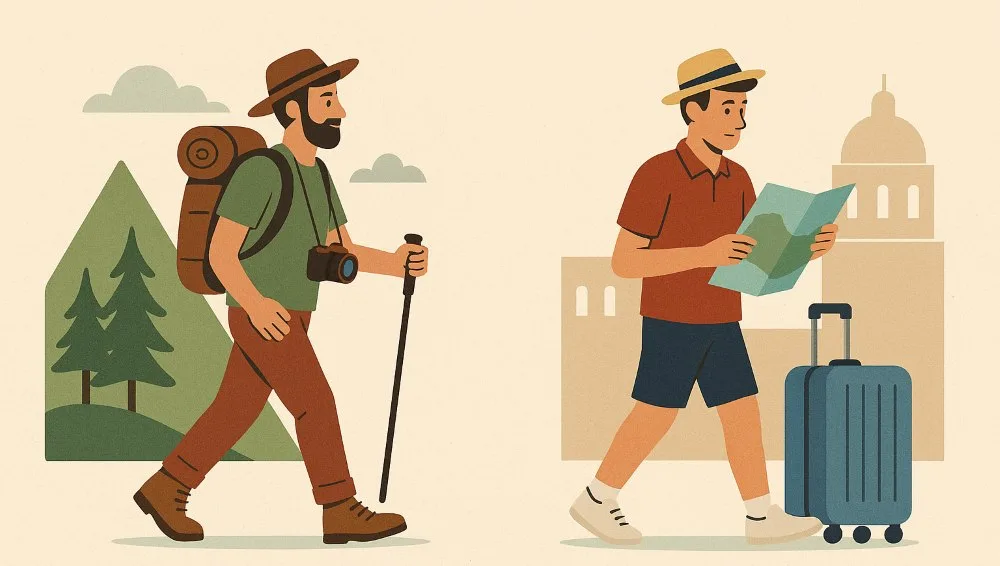
People love to call themselves travelers. It sounds adventurous, deep, and meaningful. Nobody wants to be labeled a tourist. “Tourist” feels shallow, rushed, and disconnected. But the truth is uncomfortable: most people who say they are travelers actually travel like tourists.
And there’s nothing wrong with that—unless you are lying to yourself.
Being a tourist or a traveler isn’t about money, destinations, or how far you go. It’s about mindset. It’s about how you move through a place, how you treat people, and what you expect from the journey.
So let’s be honest for a moment. Which one are you?
The Tourist Mindset
Tourists chase highlights.
Travelers chase understanding.
A tourist asks:
- “What are the top 10 places to visit?”
- “Where can I get the best photo?”
- “How fast can I cover everything?”
Tourists move in schedules. Tight plans. Booked-to-the-minute itineraries. Their trip is a checklist, not an experience.
They stay in:
- Tourist zones
- International hotels
- Places that feel familiar
They eat food that reminds them of home.
They talk mostly to other tourists.
They leave with photos but very few stories.
Tourists don’t do this intentionally. They just want comfort and control. And comfort is the enemy of discovery.
The Traveler Mindset
Travelers don’t rush.
They observe.
A traveler asks:
- “How do people live here?”
- “What’s normal for them?”
- “What can I learn?”
They stay longer in fewer places.
They walk without purpose.
They let the day shape itself.
They eat local food even when they don’t know what it is.
They take public transport.
They speak with hand gestures if language fails.
They don’t try to “conquer” a destination.
They let the destination shape them.
Tourists Collect Places. Travelers Collect Moments.
Tourists say:
“I’ve been to 12 countries this year.”
Travelers say:
“I had tea with a stranger who invited me into his home.”
One sounds impressive.
The other is unforgettable.
A tourist measures travel in numbers.
A traveler measures travel in impact.
Tourists Want Control. Travelers Accept Chaos.
Tourists fear:
- Getting lost
- Language barriers
- Unplanned situations
Travelers welcome them.
Because getting lost leads to discovery.
Confusion leads to conversation.
Mistakes lead to memory.
Tourists avoid uncertainty.
Travelers grow through it.
Tourists Look. Travelers Participate.
Tourists watch culture.
Travelers step into it.
Tourists photograph festivals.
Travelers ask why they exist.
Tourists see people as background.
Travelers see people as the destination.
Are Tourists Bad? No. But Don’t Pretend You’re Not One.
Tourism is easy.
Tourism is comfortable.
Tourism is predictable.
There is nothing wrong with wanting ease. But don’t confuse ease with depth.
Most people don’t want real travel. They want controlled adventure. A version of the world that bends around their comfort.
That’s fine. Just be honest about it.
Being a traveler requires:
- Patience
- Humility
- Curiosity
- Emotional openness
Not everyone wants that.
The Problem Is Not Being a Tourist. The Problem Is Claiming to Be a Traveler.
When you call yourself a traveler but behave like a tourist, you dilute the meaning of travel.
You say you want authenticity, but you choose comfort.
You say you want culture, but you stay isolated.
You say you want adventure, but only if it’s safe and predictable.
That contradiction is where most travel loses its soul.
How to Shift from Tourist to Traveler
You don’t need extreme changes. Just intentional ones.
- Slow down
One place. More time. Less rushing. - Change where you stay
Local neighborhoods > hotel districts. - Eat without translation
Point at food. Trust the kitchen. - Use public transport
You learn more in one bus ride than in a luxury taxi. - Talk to locals
Even if it feels awkward. Especially if it feels awkward. - Let go of perfection
Your best memory won’t be planned.
The Hard Truth
Most people want to feel like travelers without behaving like one.
They want the identity, not the discipline.
They want the story, not the discomfort.
They want the label, not the lifestyle.
Being a traveler isn’t about how far you go.
It’s about how deeply you engage.
Final Question
Next time you travel, ask yourself:
Are you collecting photos…
or collecting perspective?
Are you moving through a place…
or letting the place move you?
Tourist or traveler.
There is no wrong choice.
Only honest ones.